
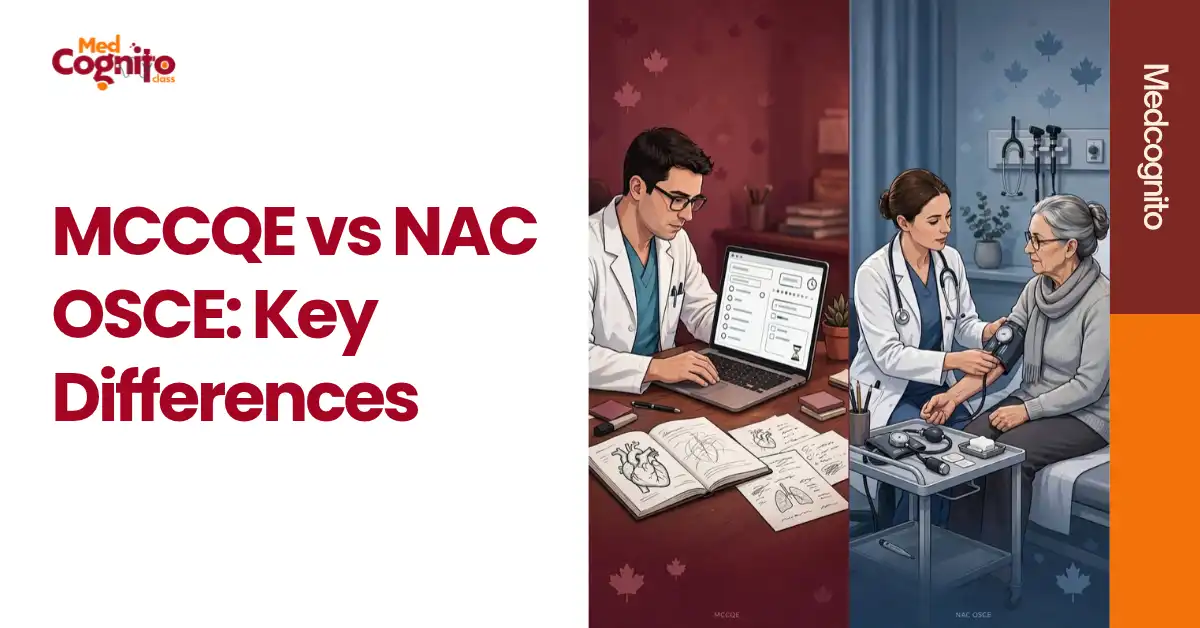
If you are an international medical graduate (IMG) planning to enter residency in Canada, you will probably encounter two major examinations: the Medical Council of Canada Qualifying Examination (MCCQE) and the National Assessment Collaboration (NAC) Examination, commonly called the NAC OSCE.
They are not two versions of the same exam. The MCCQE primarily tests whether you can apply medical knowledge and clinical decision-making through multiple-choice questions. The NAC tests whether you can demonstrate clinical and communication skills in timed patient encounters.
For many IMGs pursuing the CaRMS R-1 residency route, both examinations are relevant. Understanding the difference helps you prepare for each exam correctly and plan your residency timeline.
MCCQE vs NAC OSCE: Quick Comparison
| Feature | MCCQE | NAC Examination |
|---|---|---|
| Main purpose | Assesses critical medical knowledge and clinical decision-making | Assesses clinical skills and behaviours relevant to entry into postgraduate training |
| Exam type | Computer-based MCQ examination | Objective structured clinical examination (OSCE) |
| Current format | 230 MCQs in 2 sections | 12 clinical stations: 10 scored + 2 pilot |
| Timing | 2 hours 40 minutes per section | 11 minutes per station + 2 minutes between stations |
| How you respond | Select the best answer from MCQ options | Perform clinical tasks and interact with standardized participants |
| Current score scale | 300–600 | 500–700 |
| Current pass score | 439 | 577 |
| Core preparation | MCQ reasoning, content review, timing, Canadian clinical context | Timed clinical stations, communication, history, examination and management |
| Relevant to IMG CaRMS R-1 route? | Yes, subject to current eligibility rules | Yes, subject to current eligibility rules |
What Is the MCCQE?
The MCCQE is the Medical Council of Canada Qualifying Examination. It was formerly widely referred to as the MCCQE Part I or MCCQE1.
The current exam is MCQ-only. It contains 230 multiple-choice questions divided into two sections of 115 questions, with up to 2 hours and 40 minutes per section. The former Clinical Decision-Making write-in component was removed in April 2025, although clinical decision-making continues to be assessed through MCQs.
The current reporting scale is 300 to 600, with a pass score of 439.
For more detail, see our complete guide to the current MCCQE format.
What Is the NAC OSCE?
The National Assessment Collaboration Examination is an objective structured clinical examination administered by the Medical Council of Canada.
The standard NAC Examination contains 12 stations. Each station lasts 11 minutes, with 2 minutes between stations. Ten stations contribute to the score and two are pilot stations.
Instead of answering MCQs, candidates may need to take a focused history, perform or describe an examination, interpret clinical information, discuss investigations, formulate a diagnosis or management plan, and communicate with a standardized participant.
The current NAC score scale is 500 to 700, with a pass score of 577.
See our complete NAC OSCE guide for format, scoring and preparation details.
1. MCCQE Tests Decisions on Screen; NAC Tests Clinical Performance
The most important difference is how you demonstrate competence.
On the MCCQE, you read a clinical scenario and select the best answer. You may be asked for the most likely diagnosis, most appropriate investigation, next step in management, preventive intervention or best response to an ethical situation.
On the NAC, you must perform within a clinical encounter. Knowing what you should do is not enough if you cannot organize the encounter, communicate effectively and complete the required task within the station time.
This means strong MCCQE performance does not automatically translate into strong NAC performance, and vice versa.
2. The Preparation Methods Are Different
MCCQE preparation should emphasize:
- MCQ-based clinical reasoning;
- MCC Examination Objectives;
- content gaps;
- Canadian ethics and preventive care;
- timed question blocks;
- review of incorrect answers; and
- exam stamina.
NAC preparation should emphasize:
- focused history taking;
- physical examination;
- clinical reasoning spoken or demonstrated in context;
- communication and counselling;
- organization within an 11-minute station;
- repeated role-play or standardized-patient practice; and
- specific feedback on performance.
Trying to prepare for the NAC primarily by reading MCQ explanations is a mistake. Likewise, practising OSCE scripts alone will not adequately prepare you for 230 MCCQE questions.
3. MCCQE and NAC Assess Overlapping Knowledge in Different Ways
The two examinations share a clinical foundation. Both can require you to recognize common presentations, prioritize safe care, investigate appropriately, manage patients and communicate according to Canadian expectations.
But the assessment method changes what good performance looks like.
For example, in an MCCQE question you might need to select the most appropriate next investigation. In a NAC station, you may need to obtain the relevant history, recognize the likely problem, explain your reasoning and discuss investigations while interacting professionally with the patient.
4. Which Exam Is Harder: MCCQE or NAC?
There is no objective answer that applies to every candidate because the examinations challenge different skills.
The MCCQE may feel harder if you struggle with broad medical knowledge, MCQ interpretation, Canadian clinical decision-making or maintaining concentration over a long computer-based examination.
The NAC may feel harder if you struggle with spoken communication, performing under observation, physical examination, station organization or making clinical decisions while interacting with a patient.
For an IMG, your previous training can strongly influence which exam feels more difficult.
5. Do IMGs Need Both MCCQE and NAC for CaRMS?
For IMGs pursuing the standard CaRMS R-1 Main Residency Match route, the MCCQE and NAC Examination are generally part of the basic examination requirements.
However, examination results are not the only eligibility requirements. CaRMS eligibility can also depend on citizenship or permanent-resident status, medical-school eligibility, provincial criteria, language requirements and individual program rules.
Always check the requirements for the current match cycle and each program to which you intend to apply.
Our guide on what to do after passing the MCCQE explains how the examinations fit into the broader residency pathway.
6. Do You Have to Pass the MCCQE Before Taking the NAC?
Not as a universal rule.
Current MCC guidance allows eligible candidates who need both examinations for the CaRMS R-1 match to take the MCCQE and NAC Examination in the order they prefer.
This is important because older resources may still present the pathway as though every IMG must complete the MCCQE first and only then become eligible for the NAC.
Your actual sequence should consider eligibility, available examination sessions, preparation needs, result-release timing and CaRMS deadlines.
See our NAC eligibility guide for a more detailed explanation.
7. Should You Take the MCCQE or NAC First?
If you are eligible for both, there is no single best order for every IMG.
Taking the MCCQE first may make sense if:
- your medical knowledge needs structured review before OSCE preparation;
- your planned MCCQE date comes earlier;
- you want to strengthen clinical reasoning before intensive station practice; or
- your schedule allows you to focus on one examination at a time.
Taking the NAC first may make sense if:
- a suitable NAC session fits your CaRMS timeline;
- you already have strong recent clinical knowledge;
- you need to secure a limited OSCE preparation window; or
- waiting for the MCCQE would unnecessarily delay your residency plan.
The better question is not “Which exam is officially first?” but “Which sequence allows me to be adequately prepared and have the required results available for my intended pathway?”
8. How Are the MCCQE and NAC Scored?
MCCQE scoring
The current MCCQE is reported on a 300–600 scale. The current pass score is 439. Candidates who meet or exceed the passing standard pass the examination.
NAC scoring
The current NAC Examination is reported on a 500–700 scale. The current pass score is 577. Ten operational stations contribute to the score; two pilot stations do not.
Neither examination should be interpreted using unofficial internet categories as though the MCC publishes fixed “good,” “competitive” and “excellent” score bands.
Read our guides to MCCQE score interpretation and NAC OSCE score interpretation for more detail.
9. Can You Retake the Exams After Passing?
The retake rules are not identical.
For the MCCQE, candidates who achieve a pass result cannot retake the examination simply to obtain a higher score.
NAC retake rules should be checked against current MCC policy if you are considering another attempt. Because residency programs and match processes may use examination results differently, confirm the consequences before deciding whether a retake is appropriate.
10. What Happens After You Pass Both Exams?
If you are pursuing the CaRMS R-1 route, passing both exams does not automatically produce a residency position.
Your attention then shifts toward:
- confirming CaRMS and provincial eligibility;
- selecting programs;
- transferring required documents and examination data;
- obtaining references;
- preparing personal or program-specific documents;
- completing interviews;
- submitting your rank order list; and
- meeting any additional program or provincial requirements.
For an overview, read What Is CaRMS?.
MCCQE vs NAC OSCE Preparation: What Should You Practise?
| Preparation Area | MCCQE | NAC OSCE |
|---|---|---|
| Medical knowledge review | High priority | Important, but applied during stations |
| MCQ practice | Essential | Not the main exam skill |
| Timed patient encounters | Not applicable | Essential |
| Communication role-play | Useful for concepts | Essential |
| Physical examination practice | Knowledge may be tested | Performance can be assessed |
| Canadian ethics/context | Important | Important |
| Long exam stamina | Important | Different stamina: repeated high-intensity stations |
| Performance feedback | Question analytics/error review | Direct observation and station feedback |
How MedCognito Supports Both Pathways
Because the examinations assess different skills, MedCognito uses different preparation approaches for each.
For the MCCQE, candidates can use structured teaching and MedBuddy for question practice, mock exams, readiness insights, adaptive study planning and targeted review.
Explore the MedCognito MCCQE preparation course if you want structured MCCQE support.
For the NAC, preparation should emphasize active OSCE performance, timed cases, communication and feedback. See the MedCognito NAC OSCE preparation course.
Frequently Asked Questions
Is MCCQE the same as NAC OSCE?
No. The MCCQE is a computer-based MCQ examination of medical knowledge and clinical decision-making. The NAC is an OSCE that assesses clinical and communication skills through timed patient encounters.
Do I need MCCQE before NAC OSCE?
Not as a universal sequencing requirement. Eligible candidates who need both for the CaRMS R-1 pathway can plan the order according to current MCC rules, examination availability and their residency timeline.
Do IMGs need both exams for residency in Canada?
For the standard CaRMS R-1 IMG pathway, both examinations are generally relevant, but candidates must also meet national, provincial and program-specific eligibility criteria.
Which exam should I prepare for first?
Choose based on your eligibility, baseline skills, available exam sessions, preparation time and CaRMS deadlines. Do not assume the MCCQE must always be completed first.
What is the MCCQE pass score?
The current MCCQE pass score is 439 on a 300–600 reporting scale.
What is the NAC OSCE pass score?
The current NAC pass score is 577 on a 500–700 reporting scale.
Which exam is more practical?
The NAC. It requires candidates to demonstrate clinical and communication skills in OSCE stations. The MCCQE assesses clinical knowledge and decision-making through MCQs.
Final Takeaway
The MCCQE and NAC OSCE serve different purposes in the Canadian IMG pathway.
The MCCQE asks whether you can identify and apply the best medical decision through MCQs. The NAC asks whether you can demonstrate clinical competence and communication in a timed patient encounter.
For many IMGs pursuing Canadian residency through CaRMS, both examinations matter. Prepare for them as separate assessments, plan their timing around the match cycle, and verify current eligibility requirements rather than relying on an outdated fixed sequence.