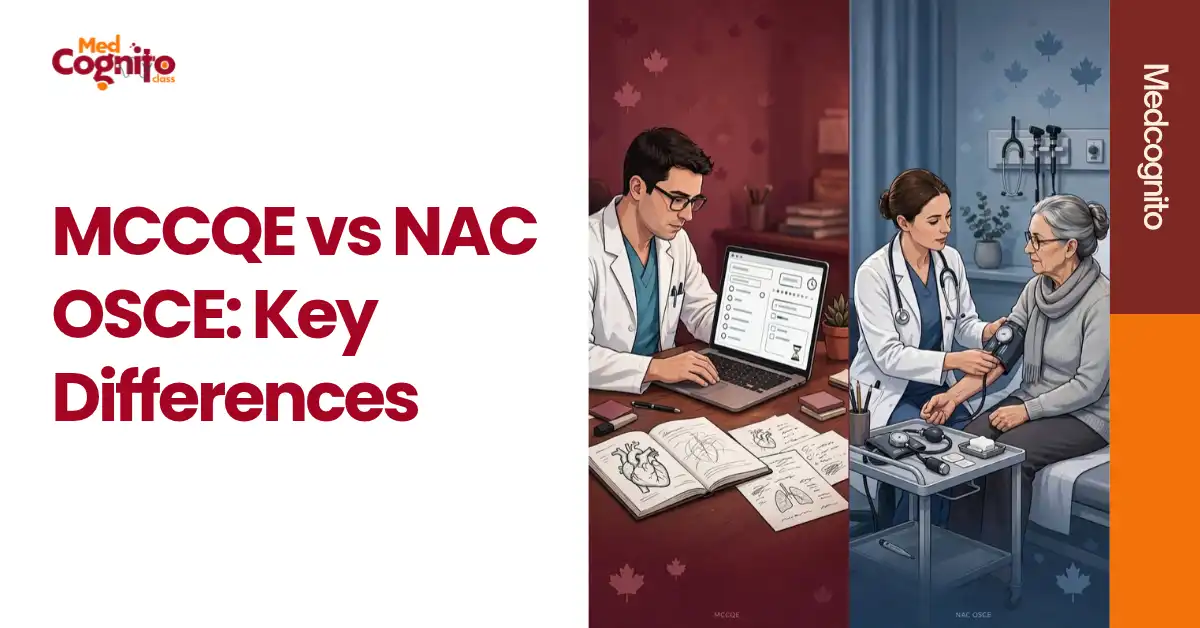

For international medical graduates (IMGs), the National Assessment Collaboration (NAC) Examination is an important assessment of readiness to enter Canadian residency training. If you are preparing for the exam, one of the most common questions is simple: what is a good NAC OSCE score?
The most useful answer starts with the official Medical Council of Canada (MCC) scoring system. The current NAC Examination score is reported on a 500–700 scale, and the pass score is 577. The MCC does not publish official score bands labelled “good,” “competitive,” or “excellent,” so candidates should be cautious about treating unofficial cut-offs as guarantees of residency competitiveness.
What Is the NAC Examination?
The NAC Examination is a national Objective Structured Clinical Examination (OSCE) administered by the MCC. It assesses whether international medical students and graduates are ready to enter supervised postgraduate training in Canada.
For a standard administration, the exam contains 12 stations. Ten stations contribute to your final score and two are pilot stations that do not. Each station is 11 minutes long, with two minutes between stations.
The MCC assesses candidates on up to seven competencies:
- History taking
- Diagnosis
- Management
- Communication skills
- Physical examination
- Investigations
- Data interpretation
For a broader overview of the examination, see our NAC OSCE exam guide.
How Is the NAC OSCE Scored?
Your total NAC Examination score is reported on a scale from 500 to 700. The current pass score is 577.
- 577 or higher: Pass
- Below 577: Fail
The NAC Examination is criterion-referenced. This means your pass/fail result is determined by whether your performance meets the established standard, rather than by how well other candidates perform.
Each of the 10 scored stations contributes equally to the total score. The MCC calculates the total from the average of those station scores and uses a statistical linking process to account for differences in station difficulty across exam dates.
Your Statement of Results includes your final result, total score and the score required to pass. The Supplemental Information Report provides additional performance feedback, including subscores and comparisons that can help you understand your relative strengths and weaknesses.
What Is a Good NAC OSCE Score?
There is no official MCC threshold for a “good,” “competitive,” or “excellent” NAC OSCE score. The official threshold is the pass score of 577.
Therefore, the most accurate way to interpret a result is:
- Below 577: You have not met the current passing standard.
- 577 or above: You have met the current passing standard.
- Higher scores: They indicate stronger overall performance on the examination, but the MCC does not define specific higher-score bands as “competitive” or “excellent.”
A previous version of this article described 602 as “good,” 622 as “competitive,” and 627+ as “excellent.” Those are not official MCC classifications, so we no longer recommend using them as fixed benchmarks.
Does a Higher NAC OSCE Score Improve Your Residency Chances?
A higher score can provide additional information about your examination performance, but it should not be interpreted as a guaranteed residency-match threshold. Residency selection is broader than one examination result, and program requirements and selection processes can vary.
If you are preparing for residency applications, treat the NAC Examination as one important part of the overall process rather than assuming that a particular score guarantees an interview or match.
Why You Should Not Compare Current Scores Directly With Older NAC Scores
The NAC Examination has used different reporting scales over time. Because the reporting framework has changed, older scores should not be directly compared with results reported on the current 500–700 scale.
The current pass score of 577 was established for the scoring framework introduced in May 2023. When interpreting your result, use the scoring information provided for your own examination session rather than an older candidate’s numerical score.
How NAC OSCE Stations Are Assessed
Physician examiners observe candidates interacting with standardized participants and score performance using standardized instruments. Depending on the station, these can include task checklists, oral-question answer keys and competency rating scales.
The exam therefore requires more than memorizing medical facts. You need to demonstrate clinical reasoning, structured history taking, appropriate examination and investigation choices, management decisions and effective patient-centred communication.
How to Improve Your NAC OSCE Performance
1. Understand the MCC Examination Objectives
The MCC Examination Objectives form the foundation for NAC Examination content. Use them to identify clinical presentations and professional competencies you need to practise rather than relying on random case lists.
2. Practise Complete Timed Stations
Knowing what to ask is different from performing effectively within an 11-minute station. Practise cases under realistic time constraints so that history, examination, clinical reasoning and communication become structured and efficient.
3. Get Specific Feedback
Generic feedback such as “practise more” is difficult to act on. Ask for feedback on individual components: organization, missed questions, differential diagnosis, examination technique, management, communication and timing.
4. Practise Communication as a Clinical Skill
Communication is explicitly assessed. Work on explaining your reasoning clearly, responding to patient concerns, avoiding unnecessary jargon, checking understanding and maintaining a patient-centred approach.
5. Review Weak Areas Systematically
After mock stations, identify patterns rather than treating every error independently. If you repeatedly struggle with management, counselling or focused physical examinations, make that weakness a specific part of your next practice cycle.
For a complete preparation framework, read How to Prepare for the NAC OSCE. If you are concerned about unsuccessful attempts, our guide on what to do after a failed NAC OSCE explains how to reassess your preparation.
Should You Aim Only for 577?
No. Although 577 is the current pass standard, your preparation goal should be consistent clinical performance rather than trying to calculate the minimum performance needed to reach one number.
Practise until you can repeatedly perform common station tasks under timed conditions, communicate clearly and respond appropriately to different clinical scenarios. This gives you a more useful preparation target than chasing an unofficial “competitive score.”
Prepare for the NAC OSCE With MedCognito
MedCognito’s NAC OSCE preparation course provides structured preparation for candidates who want guided practice, exam strategies and clinical station preparation. Use it alongside the MCC Examination Objectives and official MCC exam information so that your preparation remains aligned with the current examination.
Frequently Asked Questions
What is the current NAC OSCE passing score?
The current NAC Examination pass score is 577 on a reporting scale from 500 to 700.
Is 600 a good NAC OSCE score?
A score of 600 is above the current passing score of 577. However, the MCC does not officially classify 600 as a “good” score or publish a specific competitive-score threshold.
Is 622 a competitive NAC OSCE score?
The MCC does not designate 622 as an official competitive threshold. Avoid treating a particular higher score as a guarantee of residency competitiveness.
How many NAC OSCE stations count toward my score?
Ten stations contribute to your final score. The standard examination contains 12 stations in total, with two pilot stations that do not count toward the final score.
Can I retake the NAC Examination to improve my score?
The MCC states that candidates may retake the NAC Examination to attempt to improve their score. If you take the examination more than once, the most recent result is the valid result.
Final Thoughts
A 577 or higher is a passing NAC Examination score, but there is no official MCC definition of a “good,” “competitive,” or “excellent” higher score. Rather than relying on unofficial numerical bands, focus on developing consistent performance across the clinical competencies the NAC Examination actually assesses.
Use official MCC information as the source of truth for scoring and exam format, practise realistic timed stations, and use targeted feedback to improve weak areas before exam day.