
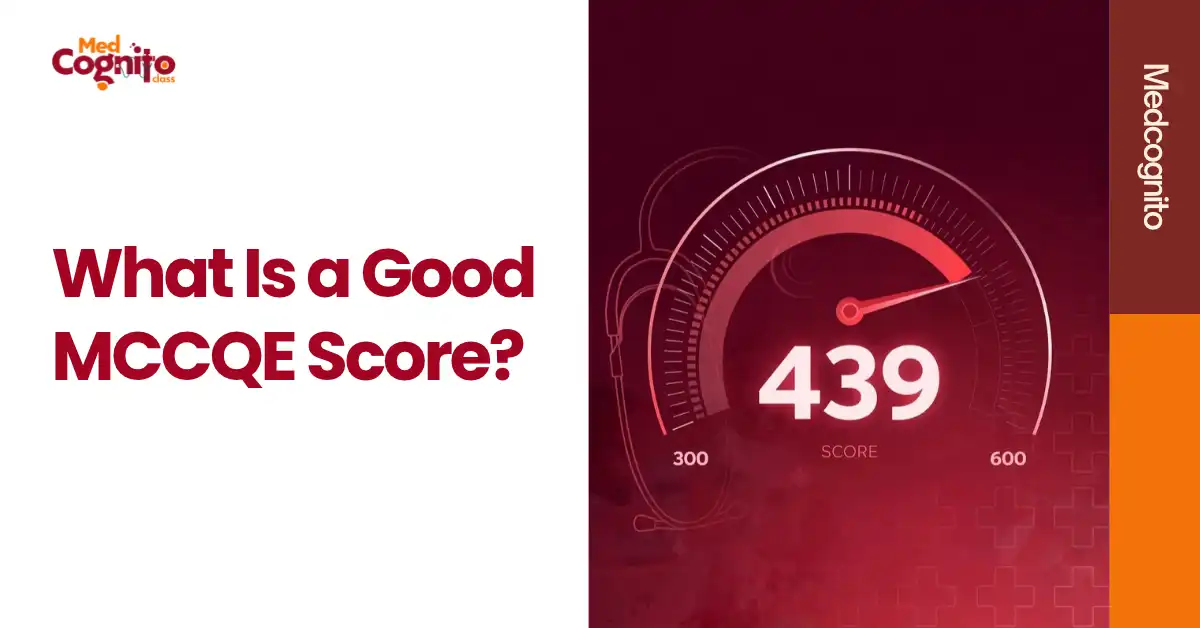
A good MCCQE score is any score that achieves your immediate goal, but the most important official benchmark is the current pass score of 439. The MCCQE is reported on a scaled score from 300 to 600. The Medical Council of Canada (MCC) set the scale using the April 2025 examination session, with a mean of 450 and a standard deviation of 30.
There is no official MCC designation for a “good,” “very good,” or “excellent” score above the pass mark. A score of 439 or higher is a pass; beyond that, how much your exact score matters depends on why you took the exam and the requirements of the organization reviewing your application.
What Is the Current MCCQE Passing Score?
The current MCCQE pass score is 439 on a reporting scale of 300 to 600. The MCC introduced this reporting scale with the revised examination in April 2025. The scale was established with a mean of 450 and a standard deviation of 30 based on results from that examination session.
The MCC’s 2025 standard-setting technical report explains that a panel of physicians recommended the new passing standard, which corresponds to 439 on the reporting scale.
What Counts as a Good MCCQE Score?
There is no official score band that defines a “good” MCCQE result. It is more accurate to interpret scores in relation to the pass threshold and your purpose for taking the examination.
- Below 439: This is below the current passing standard.
- 439 or higher: You have met the MCCQE passing standard.
- Scores comfortably above 439: These indicate performance above the minimum passing threshold, but the MCC does not label a particular score above 439 as “good” or “excellent.”
Avoid treating unofficial internet score bands as MCC classifications. They can make a precise-looking distinction that the MCC itself does not make.
How Does the MCCQE Scoring Scale Work?
Your MCCQE result is reported as a scaled score, not simply as the percentage of questions you answered correctly. According to the MCC’s sample Statement of Results for the revised examination, total scores range from 300 to 600.
This means a score of 450 should not be interpreted as “75%” simply because 450 is three quarters of 600. Scaled scores and raw percentages are different measures.
The examination also includes unscored pilot questions. For a breakdown of the current structure, read our MCCQE exam format guide.
Why Did the MCCQE Passing Score Change?
The exam changed substantially in April 2025. The former clinical decision-making (CDM) write-in component was removed, and the current examination is MCQ-only. The MCC therefore conducted a new standard-setting exercise for the revised examination.
A panel of 23 physicians participated in the process. The recommended standard was ultimately reported as a pass score of 439 on the new 300–600 scale. This is why candidates should be cautious when reading older articles, videos or forum discussions that quote previous MCCQE Part I scores.
Is 450 a Good MCCQE Score?
A score of 450 is above the current pass score of 439. It is also the mean used when the MCC established the new reporting scale using the April 2025 session. It therefore represents a passing result, but it should not be described as an official MCC “good score” category because no such category exists.
Is 500 a Good MCCQE Score?
A score of 500 is well above the 439 passing standard. Numerically, it is also above the 450 reference mean used to establish the current scale. However, candidates should still avoid assuming that a particular score automatically guarantees a residency interview, licence or other application outcome. Those processes can consider multiple criteria.
Does Your MCCQE Score Matter for Residency?
Your MCCQE result may form part of an application or selection process, particularly for international medical graduates, but requirements and selection practices can differ by province, program and match cycle. Passing the MCCQE should not be confused with automatically securing a residency position.
If residency is your goal, check the current requirements for the programs and jurisdictions to which you plan to apply rather than relying on a universal “competitive score.” Requirements can change.
Does a High MCCQE Score Guarantee Residency in Canada?
No. A high MCCQE score does not guarantee a Canadian residency position. Residency selection can involve eligibility rules, other examinations where applicable, academic and clinical history, references, interviews and program-specific criteria.
Your MCCQE performance is therefore one component of a broader application rather than a standalone guarantee.
What If Your Practice Scores Are Below Your Target?
Do not convert question-bank percentages directly into predicted MCCQE scaled scores unless the resource provides a validated method for doing so. Instead, use practice performance diagnostically.
- Identify subjects where errors recur.
- Separate knowledge gaps from reasoning or question-reading errors.
- Review why incorrect options are wrong, not only why the correct answer is right.
- Use mixed and timed questions as your exam date approaches.
- Track trends across multiple sessions rather than reacting to one poor set.
Our guide to common MCCQE MCQ traps explains several reasoning errors that can cost candidates marks even when they know the underlying medicine.
How Should You Prepare for a Strong MCCQE Result?
Focus on understanding clinical presentations and selecting the most appropriate next step in Canadian clinical scenarios. Combine targeted content review with repeated MCQ practice and careful review of mistakes.
MedBuddy by MedCognito can support this process through question practice, mock exams, readiness insights, adaptive study planning and targeted review. The aim should be consistent improvement in clinical reasoning rather than chasing an arbitrary question-bank percentage. You can also use our MCCQE study plan to structure your preparation.
Frequently Asked Questions
What score do you need to pass the MCCQE in 2026?
The current passing score is 439 on a scaled reporting range of 300 to 600.
What is the average MCCQE score?
The current reporting scale was established with a mean of 450 and a standard deviation of 30 using the April 2025 examination session. This does not mean every future examination session will have an observed candidate average of exactly 450.
Is 439 a good MCCQE score?
439 is the current passing standard. It means you have met the examination’s minimum passing requirement. The MCC does not classify 439 or any higher score using official labels such as “good” or “excellent.”
Can I convert my MCCQE score into a percentage?
You should not calculate a percentage by simply dividing your scaled score by 600. The reported MCCQE score is a scaled score and is not equivalent to a raw percentage correct.
Does the MCCQE still have CDM questions?
The former CDM write-in section was removed in April 2025. Clinical decision-making is still assessed through the current multiple-choice examination.
Final Thoughts
For the current MCCQE, 439 is the score that matters most because it is the passing standard. Scores above 439 represent performance above that threshold, but the MCC does not publish an official “good score” cutoff. If you are preparing for residency or another competitive process, check the specific requirements that apply to you and focus your preparation on strong, consistent clinical reasoning rather than an unofficial target circulating online.