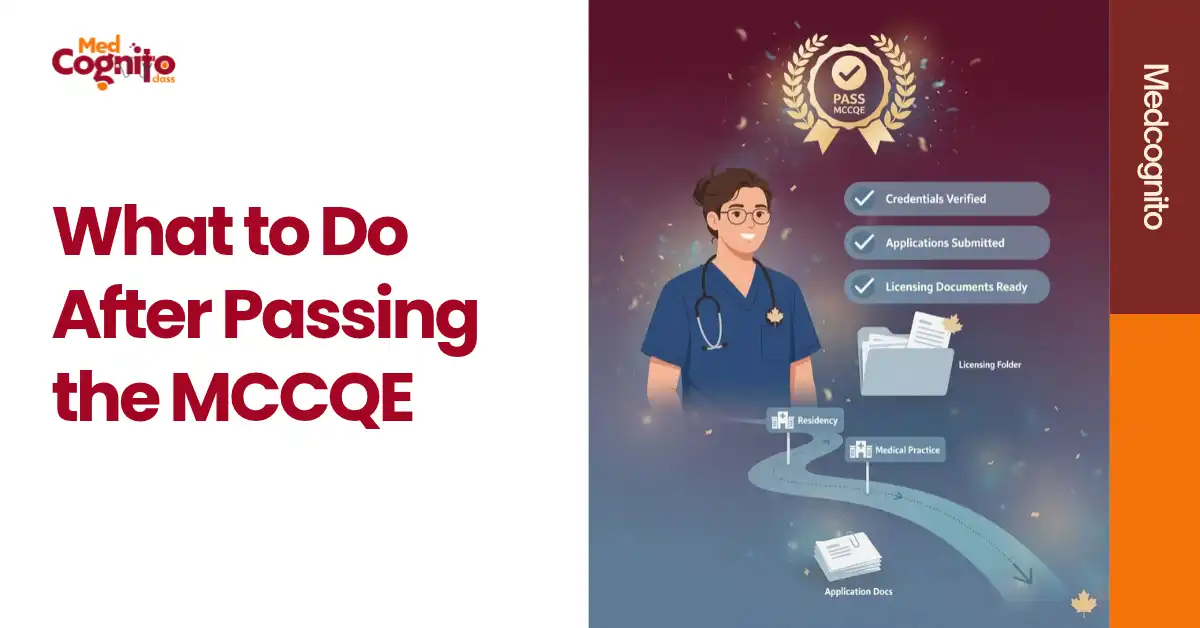
Passing the Medical Council of Canada Qualifying Examination (MCCQE) is a major milestone, but for most international medical graduates (IMGs), it is not the final step toward practising medicine in Canada.
What you should do next depends on your pathway. If your goal is Canadian residency, your next steps may include the National Assessment Collaboration (NAC) Examination, confirming your CaRMS eligibility, preparing your residency application and meeting provincial requirements. If you have already completed postgraduate training and practised independently, a Practice-Ready Assessment (PRA) or another provincial pathway may be more relevant.
The most important point is this: passing the MCCQE does not by itself give you a medical licence or a residency position. It satisfies an important examination requirement within a broader pathway.
Quick Answer: What Comes After Passing the MCCQE?
For an IMG pursuing the standard Canadian residency route, the sequence usually looks broadly like this:
- Confirm your MCCQE pass result and keep your physiciansapply.ca account and documents current.
- Determine whether you need to take or have already passed the NAC Examination.
- Check current CaRMS national, provincial and program-specific eligibility criteria.
- Prepare and submit your CaRMS residency application if eligible.
- Complete interviews and submit your rank order list.
- If matched, meet the postgraduate training and provincial registration requirements for your residency position.
- Later, meet the requirements relevant to the LMCC, specialty certification and independent provincial licensure.
Your exact sequence can differ based on your citizenship or permanent-resident status, medical school, graduation date, previous postgraduate training, province and intended pathway.
1. Understand What Passing the MCCQE Actually Means
A pass result confirms that you have met the MCCQE standard. The examination assesses critical medical knowledge and clinical decision-making at the level expected of a medical student completing a Canadian medical degree.
For IMGs, passing the MCCQE is an important credential for the residency pathway and may also be relevant to some alternative licensure pathways.
However, it is important not to confuse four different things:
- MCCQE pass: an examination result;
- CaRMS eligibility: permission to participate in the residency match under applicable criteria;
- LMCC: the Licentiate of the Medical Council of Canada, which has its own eligibility requirements; and
- medical licence: authorization from a provincial or territorial medical regulatory authority to practise medicine under the applicable class of registration.
These are related, but they are not interchangeable.
2. If You Are an IMG Seeking Residency, Check Your NAC Examination Status
For IMGs applying through the standard CaRMS R-1 residency pathway, passing the MCCQE is generally not the only examination requirement. CaRMS’ basic IMG eligibility information includes both the MCCQE and the NAC Examination.
The NAC is a clinical examination designed to assess whether candidates demonstrate the knowledge, skills and attitudes relevant to entering Canadian postgraduate medical training.
If you have not yet taken it, your next step may therefore be to confirm your eligibility, application window and preparation timeline.
Start with our complete NAC OSCE guide and NAC Examination eligibility guide.
3. Do Not Assume the MCCQE Must Always Come Before the NAC
If you are planning your examinations rather than reading this after both have been completed, do not rely on older advice that presents the MCCQE and NAC as a rigid universal sequence.
Your examination timing should be planned around current MCC rules, available sessions and the deadlines that apply to your residency cycle. The important objective for a CaRMS applicant is to have the required examination results available according to the rules and timelines that apply to the match.
This matters because waiting unnecessarily to begin NAC preparation can put pressure on your residency timeline.
4. Confirm Your CaRMS Eligibility Before Building Your Application
Passing the required examinations does not automatically make every IMG eligible for every Canadian residency program.
CaRMS eligibility depends on national and provincial criteria, and individual programs may impose additional requirements. For the R-1 Main Residency Match, IMGs should review factors such as:
- citizenship or permanent-resident requirements;
- medical school and degree eligibility;
- MCCQE and NAC requirements;
- provincial criteria;
- previous postgraduate training;
- language requirements where applicable; and
- individual program eligibility rules.
Eligibility criteria can change between match cycles. Do not build a residency strategy from an old forum post, previous year’s checklist or another applicant’s experience.
For an overview of the matching system, see What Is CaRMS?.
5. Transfer Required MCC Documents and Examination Data to CaRMS
CaRMS states that MCC examination data and documents used in the residency application process are accepted as transfers from physiciansapply.ca.
Once you are preparing your application, follow the current CaRMS instructions for transferring the required information. Do this early enough to resolve discrepancies or missing documents before deadlines become urgent.
Your physiciansapply.ca account remains important even after you pass the MCCQE because it is used for MCC services, credentials and examination information.
6. Start Building the Rest of Your Residency Application
Exam results are only one part of an IMG residency application.
Depending on the programs you apply to, your application may involve:
- medical school transcripts and supporting documents;
- personal letters or program-specific statements;
- reference letters;
- curriculum vitae information;
- clinical experiences;
- research, teaching or other relevant activities;
- language documentation where required;
- program-specific assessments or requirements; and
- interviews.
Do not wait until every examination is behind you before learning what your target programs require. A strong residency application is built over time.
7. Research Provinces and Programs Strategically
CaRMS is a national matching service, but residency eligibility is not identical across Canada.
Review the provincial criteria for every province where you are considering applying, then review the requirements of each individual program.
This is particularly important for IMGs because differences in eligibility can determine where you can submit an application at all.
Also verify the criteria for the current match cycle. Provincial policies can change, and a rule that applied in one year may be modified or withdrawn in the next.
8. Prepare for Residency Interviews
If programs select you for interview, your preparation shifts from proving examination competence to demonstrating your suitability for postgraduate training.
Programs may evaluate areas such as communication, professionalism, clinical reasoning, understanding of the specialty, teamwork, ethical judgment and your reasons for choosing the program.
Your MCCQE score cannot substitute for a weak interview. Treat interview preparation as a separate stage of your residency strategy.
9. Understand What CaRMS Matching Actually Does
CaRMS does not simply assign applicants to programs based on the highest MCCQE score.
After interviews, applicants rank programs and programs rank applicants. The matching process uses these rank order lists to determine matches.
This is why your post-MCCQE strategy should not revolve exclusively around your examination score. Eligibility, program selection, application quality, interviews and ranking decisions all matter.
See our guide to how the CaRMS match algorithm works for a detailed explanation.
10. Does Passing the MCCQE Give You the LMCC?
No. Passing the MCCQE alone does not automatically mean you have the LMCC.
A pass result on the MCCQE is one of the requirements relevant to eligibility for the Licentiate of the Medical Council of Canada. The LMCC has additional requirements, so candidates should check the MCC’s current LMCC criteria rather than treating an MCCQE pass and LMCC as the same credential.
This distinction is especially important when reading provincial licensing requirements, because a medical regulatory authority may refer specifically to the LMCC rather than simply to an MCCQE result.
11. Does Passing the MCCQE Mean You Can Work as a Doctor in Canada?
Not by itself.
Medical practice in Canada is regulated provincially and territorially. You need the appropriate registration or licence from the medical regulatory authority in the jurisdiction where you intend to practise.
For a new IMG pursuing residency, the usual route is to meet residency eligibility requirements, match to postgraduate training and obtain the appropriate registration for that supervised training.
For physicians who have already completed postgraduate training abroad and have significant independent practice experience, other pathways may exist. Read Can You Work in Canada as a Doctor Without the MCCQE? for an overview of how provincial pathways can differ.
12. Consider Whether a Practice-Ready Assessment Pathway Applies to You
Not every internationally trained physician needs to enter Canadian postgraduate training from the beginning.
Practice-Ready Assessment programs are designed for certain internationally trained physicians who already have postgraduate training and clinical practice experience. Eligibility varies by province, specialty and program.
If you are an experienced physician, investigate PRA eligibility before assuming that the CaRMS R-1 route is your only option.
The MCCQE may be an eligibility requirement for some PRA programs, but requirements are program-specific. Always check the relevant provincial authority or PRA program directly.
13. Keep Your Timeline Aligned With the Match Cycle
Once the MCCQE is complete, deadlines become just as important as examination preparation.
Create a timeline that includes:
- NAC application and examination dates if still required;
- expected result availability;
- CaRMS registration and application milestones;
- document-transfer deadlines;
- reference-letter planning;
- program application deadlines;
- interview period;
- rank order list deadlines; and
- match results.
Work backward from the match cycle you intend to enter. A missed examination or document deadline can delay your pathway even when you have already passed the MCCQE.
What If You Passed the MCCQE but Your Score Is Lower Than You Wanted?
A pass is a pass for the purpose of meeting the MCCQE passing standard, and candidates who have passed cannot simply retake the examination to improve their score.
If you are worried about residency competitiveness, focus on the parts of your application you can still influence: NAC performance where applicable, program selection, references, relevant experience, application quality and interviews.
Do not assume there is one universal MCCQE score that guarantees or prevents a CaRMS match. Programs evaluate applicants using their own selection processes.
Our guide to a good MCCQE score explains the difference between the official passing standard and the idea of a “competitive” score.
What If You Have Passed Both the MCCQE and NAC?
If you have passed both examinations and intend to pursue the R-1 match, your focus should shift heavily toward CaRMS eligibility and application quality.
Check the current provincial criteria, identify programs for which you are eligible, organize required documents, plan references and prepare for program-specific requirements and interviews.
Do not assume that completing both examinations means your residency application is finished. The exams open an important door; the rest of the application determines how effectively you move through it.
Frequently Asked Questions
Can I practise medicine immediately after passing the MCCQE?
No. An MCCQE pass alone is not a medical licence. You must meet the registration requirements of the provincial or territorial medical regulatory authority relevant to your pathway.
Do IMGs need the NAC after passing the MCCQE?
For IMGs pursuing the standard CaRMS R-1 residency route, the NAC Examination is generally part of the basic examination requirements alongside the MCCQE. Always verify the current match-cycle and provincial criteria.
Can I apply to CaRMS after passing the MCCQE?
Passing the MCCQE satisfies an important examination requirement, but you must also meet the other national, provincial and program-specific CaRMS eligibility requirements. For IMGs, these generally include the NAC Examination for the standard R-1 route.
Do I automatically get the LMCC after passing the MCCQE?
No. Passing the MCCQE is relevant to LMCC eligibility, but the LMCC has additional requirements.
Can I retake the MCCQE to get a higher score after passing?
No. Under the MCC’s limited-attempt policy, candidates cannot retake the MCCQE after achieving a pass result.
What should I focus on after passing both MCCQE and NAC?
If residency is your goal, shift your attention toward current CaRMS eligibility, program research, documentation, references, application quality, interviews and ranking strategy.
Final Takeaway
Passing the MCCQE is an important milestone, but it is best viewed as one completed requirement within a larger Canadian medical pathway.
For many IMGs seeking residency, the next major steps are the NAC Examination, CaRMS eligibility and the residency application process. For experienced internationally trained physicians, a PRA or another provincial pathway may be more appropriate. Later steps toward independent practice can include postgraduate training, specialty certification, LMCC requirements and provincial or territorial licensure.
Before taking your next action, identify the pathway that actually applies to you and verify the current requirements for the province, program and match cycle you intend to enter.