

Many candidates preparing for the MCCQE Part I find the results confusing. This is especially common among international and Canadian medical graduates who are unfamiliar with how the exam is scored and what a pass result actually represents.
This article provides a clear and factual explanation of the MCCQE1 scoring system explained, based strictly on guidance from the Medical Council of Canada. The goal is to help you understand how scores are calculated, how pass and fail decisions are made, and what your result does and does not mean.
How MCCQE Part I Results Are Reported
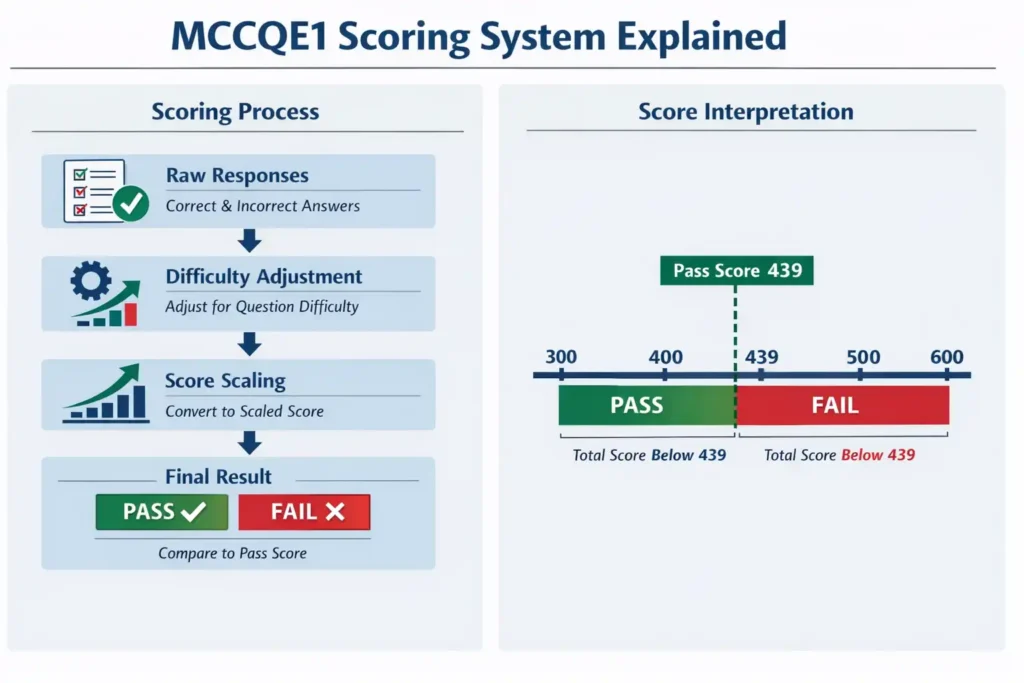
Your MCCQE Part I outcome is reported as a final result, such as pass or fail. This decision is based entirely on your total score in relation to the established pass score.
According to the Medical Council of Canada:
- A total score equal to or greater than the pass score is a pass
- A total score below the pass score is a fail
- The Exam Oversight Committee is responsible for awarding pass or fail results
Your result is not influenced by how other candidates perform.
The MCCQE1 Scoring System Explained
The Score Scale
Your total MCCQE Part I score is reported on a numerical scale with the following characteristics:
- Scores range from 300 to 600
- The pass score is 439
- The scale has a mean of 450
- The standard deviation is 30
- The mean and standard deviation were set using results from the April 2025 session
Before 2025, a different scoring scale was used. Scores from before 2025 cannot be directly compared with scores from 2025 and later.
What Determines Your Total Score
Your total score is not a simple count of correct answers. It is calculated using both your responses and the difficulty of the questions.
Key points include:
- Each multiple-choice question is scored as 1 for correct and 0 for incorrect at the raw level
- The final score accounts for the calibrated difficulty of each question
- Scores are calculated from the final set of scored items and then transformed to the reporting scale
Some questions are pilot or pretest items. These items may be included in scoring if they perform well psychometrically or after expert review. Occasionally, an item may be removed from scoring after administration. When this happens, it is excluded for all candidates.
Criterion-Referenced Scoring and What It Means
The MCCQE Part I is a criterion-referenced exam.
This means:
- Your result is determined by comparing your score to a fixed standard
- The standard is reflected by the pass score
- You can pass regardless of how well or poorly other candidates perform
You are not ranked against other candidates.
How the Pass Score Is Set
The pass score is established through a physician-led standard-setting process. For MCCQE Part I, this involves:
- Use of the Rasch model to estimate candidate ability based on response patterns and question difficulty
- Expert judgment to determine the minimum competence required to pass
- A fixed pass score on the reporting scale
The position of the pass score does not indicate exam difficulty.
Understanding the Rasch Model in Simple Terms
The Medical Council of Canada uses the Rasch model to score MCCQE Part I.
In practical terms, this means:
- Your score reflects an underlying ability estimate based on your answers
- Question difficulty is taken into account
- Scores are reported on an interval ability scale, not as percentages
Because of this, scores should not be converted to percentages. Percentages do not account for question difficulty and misrepresent what the score means.
What Your Score Does Not Represent
It is important to understand the limitations of score interpretation.
Your MCCQE Part I score:
- Is not a percentage of correct answers
- Does not rank you against other candidates
- Should not be overinterpreted based on small score differences
- Cannot be directly compared across different scoring scales
- Does not reflect exam difficulty based on where the pass score sits
Small differences in total scores may fall within the range of measurement error and should be interpreted with caution.
Subscores and Their Proper Use
Subscores are provided as part of your results, but they serve a specific purpose.
According to the Medical Council of Canada:
- Use total scores rather than subscores for interpretation
- Subscores are less reliable than total scores
- Subscores are intended as formative feedback only
- They should not be used to compare candidate performance
Exam Content and Performance Areas
The MCCQE Part I assesses performance across two broad categories, each with four domains:
- Dimensions of care
- Physician activities
These classifications help structure the exam and inform subscores, but they do not change how the final pass or fail result is determined.
Important Disclaimer on Scoring Rules
All scoring rules, models, and pass standards are set by the Medical Council of Canada and may change over time.
Candidates are strongly encouraged to:
- Verify all score interpretations through official Medical Council of Canada resources
- Use MedCognito materials as educational support only