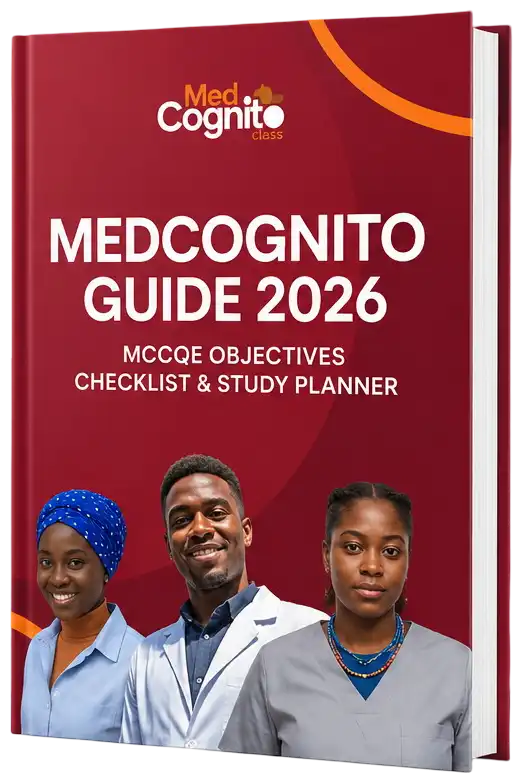


For many candidates, MedCognito can be enough as the main preparation system for the MCCQE — but only if you use it properly.
That means completing the lessons, doing the MCQs, attending or reviewing the live sessions, taking mock exams seriously, using feedback, and correcting your weak areas before exam day.
However, the most honest answer is this:
MedCognito should be your core MCCQE prep system, but you should still use official MCC preparatory products close to exam day to test your readiness.
No ethical course can promise that one platform alone will guarantee a pass. MedCognito itself states in its FAQ that no ethical exam prep platform can guarantee a pass, but that it provides the structure, tools, and guidance needed to maximize your chances when used consistently.
That is the right way to think about it.
MedCognito gives you structure, clinical reasoning support, MCQ practice, mocks, guidance, and accountability. The official MCC preparatory products help you experience the closest available version of official MCC-style practice before your actual exam.
Used together, they create a much stronger preparation plan.
First, Understand What the MCCQE Actually Tests
The MCCQE, formerly known as the MCCQE Part I, assesses the medical knowledge, clinical decision-making ability, skills, and judgment expected of a medical student completing medical school in Canada. The current exam assesses critical medical knowledge and clinical decision-making through multiple-choice questions.
The current MCCQE has 230 multiple-choice questions, divided into two sections of 115 questions. Candidates have up to 2 hours and 40 minutes per section.
This matters because the exam is not just testing whether you can remember facts.
It tests whether you can apply knowledge in a Canadian clinical context. That includes diagnosis, investigation, management, ethics, communication, patient safety, prevention, public health, and clinical prioritization.
So when asking whether MedCognito is “enough,” the real question is:
Does MedCognito help you build the knowledge, reasoning, timing, and exam strategy needed for the current MCQ-only MCCQE?
For many candidates, the answer is yes — if they commit to the full system.
What MedCognito Does Well
MedCognito is strongest as a structured MCCQE preparation system, especially for International Medical Graduates who need guidance, accountability, and Canadian-style clinical reasoning support.
According to MedCognito’s MCCQE course page, the course includes a step-by-step review of MCCQE objectives, virtual lectures, practical medical scenarios, access to a private support group, and 5000+ system-based MCQs and mocks.
MedCognito also lists full video library access, mock exams, personalized feedback, live sessions, Q&A replays, and a downloadable study plan as part of its MCCQE bundle.
That is important because most candidates do not struggle only because they lack resources. Many struggle because they have too many resources and no clear system.
They jump from one question bank to another, watch random videos, download outdated notes, join multiple Telegram groups, and still do not know what to focus on.
MedCognito’s main value is that it helps reduce that confusion.
The Honest Answer: MedCognito Can Be Enough, But Not Passively
MedCognito is not enough if you only watch a few videos and assume you are ready.
It is not enough if you avoid mock exams.
It is not enough if you do not review your mistakes.
It is not enough if you keep postponing difficult topics.
It is not enough if you treat it like passive content instead of an active exam-prep system.
But MedCognito can be enough as your main preparation platform if you use it correctly.
That means:
- follow the study plan;
- complete the high-yield lessons;
- practise the MCQs;
- review explanations carefully;
- attend live sessions or watch replays;
- participate in support discussions;
- take mock exams seriously;
- use feedback to close knowledge and reasoning gaps;
- add official MCC prep products before exam day.
The difference is not just whether you enroll. The difference is how consistently you work through the system.
Why Some Candidates May Still Need Extra Resources
The MCCQE is broad. No serious candidate should approach it casually.
Even if MedCognito is your main resource, some candidates may still benefit from extra practice or targeted reading.
You may need supplementary resources if:
- you have major knowledge gaps from medical school;
- you have been away from clinical practice for years;
- you struggle with timed MCQs;
- you repeatedly miss ethics or preventive care questions;
- you need more question volume;
- you want additional exposure to Canadian guidelines;
- you are retaking the exam after a previous failed attempt;
- your mock exam performance is still inconsistent.
This does not mean MedCognito is weak. It means your preparation should match your starting point.
A strong candidate may need MedCognito plus official MCC practice. A weaker candidate may need MedCognito, official MCC products, extra question-bank practice, and targeted guideline review.
Why Official MCC Prep Products Still Matter
Even if you use MedCognito, you should strongly consider using the official MCC preparatory products.
The MCC states that its preparatory products go through the same rigorous process as MCCQE content. The questions and answers are created by MCC subject matter experts, refined and approved by physician test committees, and based on the MCCQE blueprint.
The official MCC preparatory products include:
- Preparatory Examination: 230 MCQs
- Preparatory Examination-Lite: 115 MCQs
- correct answers
- answer rationales and references
- timed-exam mode
- self-paced mode
- six-month access
This is why official MCC products are valuable near the final stage of your preparation.
They should not replace MedCognito’s structured teaching, but they help you answer one critical question:
Am I ready for the style, timing, and reasoning level of the real MCCQE?
The Best Way to Use MedCognito for MCCQE Prep
The best approach is to use MedCognito as your main roadmap, not as just another resource.
Here is a practical structure:
Phase 1: Build your foundation
Start with MedCognito’s lessons and structured content. Your goal is to understand high-yield topics across core areas such as medicine, surgery, pediatrics, obstetrics and gynecology, psychiatry, ethics, emergency medicine, preventive care, and patient management.
Do not rush this phase. The goal is not just to “finish videos.” The goal is to understand how topics are tested.
Phase 2: Start active MCQ practice
Use MedCognito’s MCQs and mocks to move from passive learning to active recall.
For each question, ask:
- What is the diagnosis?
- What is the question really asking?
- Is it asking for investigation, treatment, prevention, ethics, or next best step?
- Why is the correct answer better than the distractors?
- What clue did I miss?
This is where MCCQE improvement happens.
Phase 3: Use feedback and support
MedCognito offers personalized support, guidance, live sessions, Q&A replays, and mock exam feedback.
Use that support. If you are stuck, ask questions. If your mock score is weak, identify the pattern. If you keep missing the same type of question, fix the reasoning gap instead of simply doing more questions.
Phase 4: Add official MCC prep products
Once you are closer to exam day, use MCC official preparatory products to assess readiness.
Do this under timed conditions. Then review every mistake carefully.
At this stage, you are no longer studying broadly. You are correcting specific weaknesses.
Phase 5: Final exam simulation
In the final weeks, practise longer blocks. The MCCQE has two sections of 115 MCQs, so you need stamina and pacing.
Your goal is to enter the exam with a tested strategy, not just hope.
Who Is MedCognito Enough For?
MedCognito may be enough as the main preparation system if you are:
- an IMG who needs structure and guidance;
- overwhelmed by too many resources;
- unsure how to study for the Canadian clinical context;
- looking for MCQs, mocks, and feedback;
- willing to follow a study plan consistently;
- ready to ask questions and use support;
- able to supplement with official MCC prep products near exam day.
It is especially useful for candidates who need someone to help them focus.
In one MedCognito student interview transcript shared for this article, the candidate described needing guidance during a short preparation period, studying consistently for two to three hours daily, and finding the program organized because important topics were covered through lectures and questions.
That is the type of candidate MedCognito helps most: someone who needs a clear path and is ready to work.
Who May Need More Than MedCognito?
You may need more than MedCognito if you are starting with a weak clinical foundation or if your practice scores remain low after completing the course.
You may also need extra resources if you want more question volume. In that case, adding a question bank such as CanadaQBank, UWorld, or another MCCQE-focused Qbank can help — not because MedCognito is insufficient, but because question repetition builds speed, pattern recognition, and confidence.
You may also need targeted guideline review if you keep missing Canadian-specific topics such as screening, preventive care, ethics, capacity, confidentiality, occupational health, public health reporting, or immunization.
The key is not to collect resources endlessly.
The key is to diagnose your weakness and add only what solves that weakness.
Is MedCognito Better Than Just Using a Question Bank?
For many IMGs, yes.
A question bank gives you questions. MedCognito gives you a preparation system.
That difference matters.
A Qbank can help you practise, but it may not tell you what to prioritize, how to interpret Canadian-style reasoning, how to structure your week, or how to fix your repeated mistakes.
MedCognito’s FAQ says the platform is designed for IMGs, final-year medical students, and doctors re-licensing in a new country, with structured study plans, high-yield content, practice questions, and exam-focused guidance.
That is why MedCognito is more useful for candidates who need more than raw question volume.
The strongest plan is usually:
MedCognito for structure + Qbank practice if needed + official MCC products for final readiness.
What About the Claim That MedCognito Alone Is Not Enough?
You may see summaries, forums, or online discussions saying that MedCognito alone is not enough.
That statement can be true or false depending on what “alone” means.
If “alone” means enrolling in MedCognito but not completing the work, then no, it is not enough.
If “alone” means refusing to do official MCC preparatory products before the exam, that is not ideal either.
But if “alone” means using MedCognito as your main course, completing the lessons, doing the MCQs, taking mocks, using feedback, reviewing weak areas, and then confirming readiness with official MCC products, then MedCognito can absolutely be the central preparation system for many candidates.
A more accurate answer is:
MedCognito is enough as your core preparation system, but smart candidates still validate their readiness with official MCC materials and add extra resources only when needed.
That is both honest and practical.
How MedCognito Helps IMGs Specifically
IMGs often know medicine. The challenge is translating that knowledge into the Canadian exam style.
The MCCQE expects patient-centred, safe, ethical, and clinically appropriate decision-making. The exam is based on MCC objectives and a blueprint covering dimensions of care and physician activities.
That means IMGs must adjust to:
- Canadian preventive care;
- clinical prioritization;
- ethics and professionalism;
- communication expectations;
- safe management decisions;
- avoiding over-investigation;
- choosing the best next step;
- understanding how MCQs test clinical judgment.
MedCognito’s value is that it helps candidates study with this exam logic in mind.
The uploaded student transcript also highlights the importance of coaching when candidates feel overwhelmed by resources, with the candidate explaining that many candidates know the resources but are unsure what to study for a particular exam.
That is a common IMG problem. It is not just lack of resources. It is lack of direction.
Can MedCognito Help If You Have Limited Time?
Yes, but limited-time preparation is risky.
MedCognito can help candidates focus and reduce unnecessary reading, especially when time is short. In the student transcript shared for this article, the candidate said MedCognito helped her focus on important topics and avoid going back to every topic from the basics during a short preparation period.
However, candidates should not intentionally leave MCCQE preparation too late.
The safer approach is to give yourself enough time to complete the course, practise MCQs, take mocks, review mistakes, and use official MCC prep products before exam day.
MedCognito can make preparation more efficient, but it cannot replace the time needed to build competence.
Recommended MedCognito-Based Study Plan
Here is a simple way to structure your preparation.
If you have 12 weeks
Use MedCognito as your main study plan. Complete system-based lessons, practise MCQs daily, attend or review live sessions, and take mocks at planned intervals. In the final three to four weeks, use official MCC prep products and focus on weak-area correction.
If you have 8 weeks
Prioritize high-yield lessons, MCQs, mocks, and feedback. Avoid collecting too many resources. Use official MCC products in the final phase, but do not waste time switching between multiple question banks unless you clearly need more practice.
If you have 4 to 6 weeks
Use MedCognito to focus your preparation aggressively. Spend less time on passive reading and more time on MCQs, explanations, mocks, and weak-area review. This timeline is not ideal, but structure becomes even more important when time is short.
Final Verdict: Is MedCognito Enough to Pass the MCCQE?
Yes — MedCognito can be enough as your main MCCQE preparation system if you use it fully and consistently.
But the best answer is not “MedCognito only and nothing else.”
The best answer is:
Use MedCognito as your core prep system. Use official MCC preparatory products to validate readiness. Add extra Qbank or guideline review only if your weaknesses show that you need them.
That is the smartest approach for 2026 candidates.
MedCognito gives you the structure, teaching, support, MCQ practice, mocks, feedback, and IMG-focused direction. The MCC official products help you confirm whether you are ready for the real exam style.
Together, that is a much stronger path than studying randomly with too many resources.
FAQs
Is MedCognito enough to pass the MCCQE?
MedCognito can be enough as your main preparation system if you complete the course, practise MCQs, take mocks, use feedback, and study consistently. However, candidates should still use official MCC preparatory products close to exam day.
Does MedCognito guarantee a pass?
No. MedCognito’s FAQ states that no ethical exam prep platform can guarantee a pass, but that MedCognito provides structure, tools, and guidance to maximize your chances when used consistently.
Should I use official MCC prep products with MedCognito?
Yes. The MCC official preparatory products are valuable because they are created using MCC content development processes and are based on the MCCQE blueprint.
Do I need a question bank in addition to MedCognito?
Some candidates may benefit from extra Qbank practice, especially if they need more question volume. But a Qbank should support your study plan, not replace structured preparation.
Is MedCognito good for IMGs?
Yes. MedCognito is built with IMGs in mind and addresses common challenges such as unfamiliar exam formats, content overload, and lack of structured study direction.
What does MedCognito include?
MedCognito’s MCCQE course includes structured lessons, virtual lectures, practical scenarios, a private support group, and 5000+ system-based MCQs and mocks.
Is MedCognito better than studying alone?
For many candidates, yes. Studying alone can work if you are disciplined and know exactly what to do. But many IMGs benefit from structure, accountability, mock exams, and feedback.
What is the best way to use MedCognito?
Use it as your main roadmap. Follow the study plan, complete lessons, practise MCQs, review mistakes, take mocks, use feedback, and add official MCC preparatory products near exam day.